Hip Hop Hub Network
Hip Hop Hub Network: Welcome to the ultimate destination for hip hop artists, producers, and enthusiasts! Join our vibrant community to connect, collaborate, and elevate your craft. Whether you're looking to showcase your music, learn new skills, or network with industry professionals, the Hip Hop Hub Network has something for everyone. Get involved in events, workshops, and discussions that celebrate the culture and creativity of hip hop!
Powered by


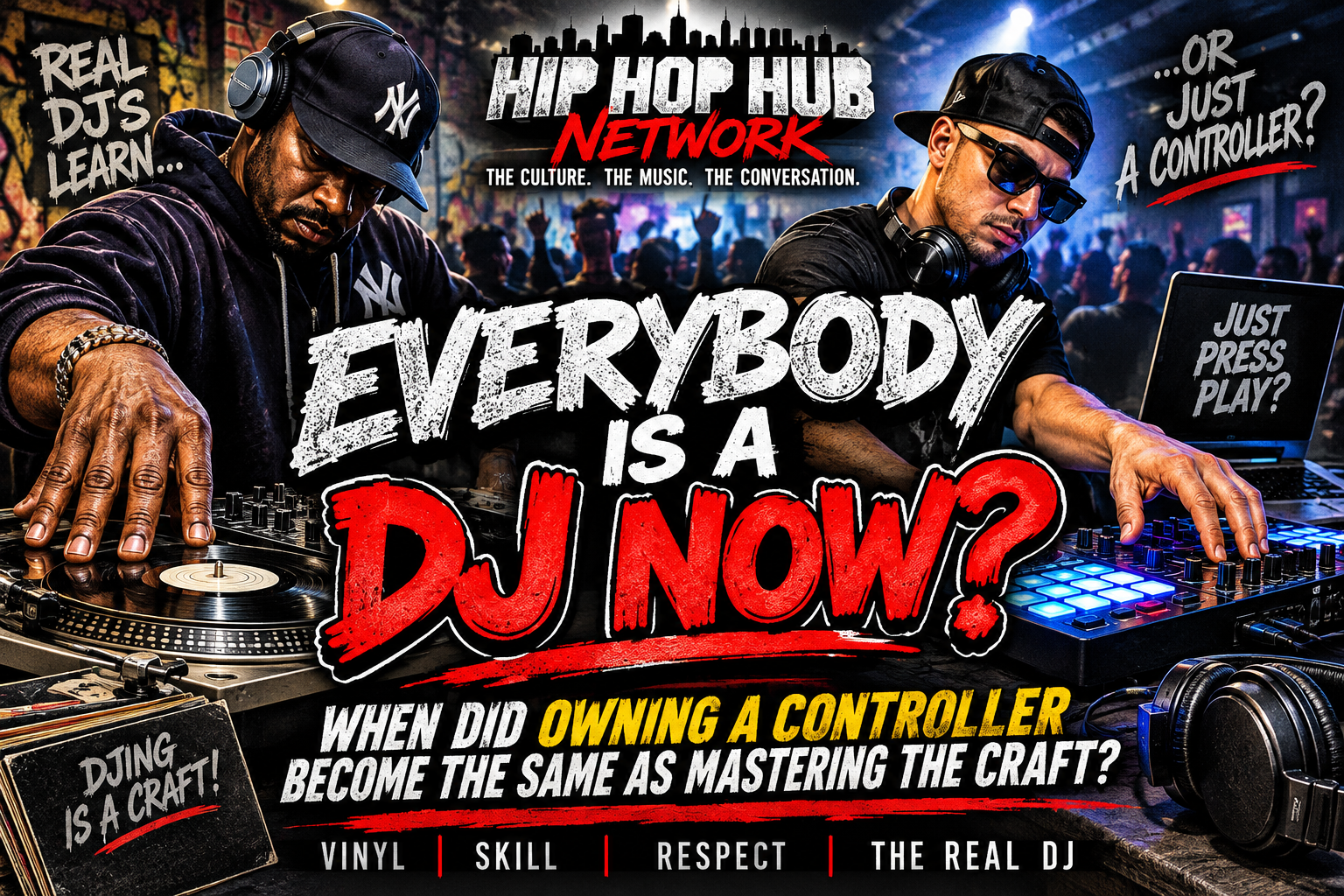
The guy working on Wall Street can be a DJ. The person sitting in their bedroom with a laptop can be a DJ. Someone buys a controller, downloads some software, watches a couple of YouTube videos, presses a few buttons, and suddenly they're advertising themselves as a professional DJ.
Everybody has a DJ name. Everybody has a logo. Everybody has a flyer. Everybody is looking for bookings.
But here's the question nobody wants to answer:
DO YOU ACTUALLY KNOW HOW TO DJ, OR DO YOU JUST KNOW HOW TO OPERATE A MACHINE?
And before anybody gets offended, let's talk about it.
BACK WHEN BEING A DJ MEANT SOMETHING
There was a time when becoming a DJ wasn't something you decided to do on a Saturday afternoon.
It was a craft.
It took patience, practice, dedication, and a serious relationship with music. You didn't just walk into a store, buy two turntables, and automatically become the neighborhood DJ.
You had to learn.
You had to understand vinyl records. You had to learn how to beatmatch by ear. You had to understand pitch control, timing, cue points, record selection, transitions, and how to keep a crowd moving without letting the music fall apart.
There was no magical SYNC button waiting to save you.
If one record was running faster than the other, YOU had to figure it out.
If your timing was off, everybody heard it.
If you missed your cue, you couldn't blame the software.
You had to develop an ear. You had to develop hands. You had to develop a feel for music.
Being a DJ was almost like learning a musical instrument. You practiced until your equipment became an extension of you.
And that's what made a great DJ different from somebody who simply played music.
THE CONTROLLER GENERATION: DID WE MAKE IT TOO EASY?
Let's be honest. Technology changed everything.
Today, you can purchase a DJ controller, connect it to a laptop, load thousands of songs, and have software automatically match the BPM of two records.
Some systems can sync your tracks, suggest transitions, display waveforms, and help you do things that once required years of practice.
Technology isn't the enemy. Progress is progress.
But here's where I have a problem.
When did having access to technology become the same thing as mastering a skill?
There are people who have never learned to beatmatch two vinyl records by ear. Never learned how to control two turntables without assistance. Never experienced the pressure of mixing records manually in front of a live crowd.
Yet they will stand next to somebody who spent years developing that skill and claim they're on the same level.
That's where the conversation gets interesting.
I'm not saying somebody using a controller cannot be a real DJ. There are incredibly talented digital DJs who understand music, mixing, timing, crowd control, and performance.
But if your entire performance depends on software doing the difficult work for you, what exactly have you mastered?
IMAGINE CALLING YOURSELF A MUSICIAN BECAUSE YOU BOUGHT A GUITAR
Think about this.
A man on Wall Street finishes his workday, goes home, buys a guitar, downloads an application, and starts calling himself a professional musician.
Would experienced musicians automatically accept him as their equal?
Probably not.
They would ask how long he's been playing. They would ask what he knows. They would want to hear what he can actually do.
So why does DJing get a different set of rules?
Why can somebody purchase a controller on Monday and advertise themselves as an experienced DJ by Friday?
The equipment doesn't give you experience. The software doesn't give you musical knowledge. And a fancy flyer doesn't make you a professional.
Your equipment is a tool. Your skill is what makes you an artist.
WE DIDN'T JUST LOSE A SKILL. WE STARTED LOSING RESPECT FOR THE CRAFT.
Hip-hop was built on creativity, innovation, and people doing things that nobody thought were possible.
Look at what DJs like Kool Herc, Grandmaster Flash, Grand Wizzard Theodore, and Grandmaster DXT helped create.
They didn't just play records. They helped turn the turntable into an instrument.
They found breaks, extended rhythms, manipulated records, created new sounds, and helped build an entire culture around the art of DJing.
That wasn't somebody pressing a button and hoping for the best.
That was innovation.
That was practice.
That was musical knowledge.
And the people who came after them continued pushing the craft forward.
But somewhere along the way, the industry started confusing accessibility with excellence.
Now everybody wants the title, the attention, the bookings, and the recognition.
But how many people actually want to put in the work?
How many want to understand the history?
How many want to learn the fundamentals before advertising themselves as the next big thing?
LET ME MAKE SOMETHING CLEAR: VINYL ISN'T THE ONLY WAY TO BE A REAL DJ.
I know somebody is already typing a paragraph about CDJs, controllers, Serato, Rekordbox, and digital technology.
Relax. I understand technology.
Some of the best DJs in the world use modern equipment. Some can take a controller and create an incredible experience. Some can read a crowd so well that they make an entire room feel like one big family.
Respect where respect is due.
But knowing how to use modern equipment doesn't mean the fundamentals no longer matter.
A real DJ should understand music beyond what the screen tells them.
Can you mix without relying on automatic beatmatching?
Can you recover when something goes wrong?
Can you read a crowd instead of simply playing a prepared playlist?
Can you build energy, control the room, and make people feel something?
Can you explain why you selected those records and why they belong together?
Can you actually demonstrate your craft?
Those are conversations worth having.
And if you can do all of that with a controller, I respect it. Show me what you can do.
But don't confuse purchasing equipment with earning respect.
THE BIGGER PROBLEM: EVERYBODY WANTS TO BE THE STAR.
The music industry already has enough problems.
Independent artists are fighting for attention. Producers are fighting to get their records heard. Real musicians are fighting for opportunities. And DJs who spent years developing their craft are now competing in a marketplace where anybody can advertise themselves as an expert.
The title has become cheap.
Everybody wants to be a DJ, but not everybody wants to be a student of music.
Everybody wants to be booked, but not everybody wants to practice.
Everybody wants the recognition, but not everybody respects the history that made the position valuable in the first place.
And that's a problem.
Because when everybody is a professional, what does being a professional actually mean anymore?
SO LET'S SETTLE THIS CONVERSATION.
I'm not asking anybody to throw away their controller.
I'm not asking anybody to stop using digital equipment.
I'm asking people to respect the difference between owning equipment and mastering a craft.
If you learned on vinyl, respect the journey.
If you learned on CDJs, respect the fundamentals.
If you learned on a controller, challenge yourself to become better than the software.
Learn the history. Learn the music. Learn the techniques. Develop your ears. Put in the hours.
Because being a DJ should mean more than having two jog wheels, a laptop, and a catchy name.
YOU CAN BUY THE EQUIPMENT. YOU CAN DOWNLOAD THE SOFTWARE. YOU CAN DESIGN THE FLYER.
BUT YOU CANNOT BUY THE YEARS OF EXPERIENCE THAT MAKE SOMEBODY GREAT AT THEIR CRAFT.
And that's the difference.
HIP HOP HUB NETWORK — THE CULTURE DESERVES A CONVERSATION.
Now I want to hear from the DJs, producers, artists, and music lovers.
QUESTION OF THE DAY:
If somebody has never learned to beatmatch manually, never touched vinyl, and depends on automatic syncing to put together a mix, should they be considered a DJ?
Or have we reached a point where anybody who owns a controller gets the title?
Let's hear it. Don't agree with me just because you like the article. Bring your argument.
Because this conversation needs to happen.
HIP HOP HUB NETWORK — PROTECT THE CULTURE. RESPECT THE CRAFT.
Related Blogs
View All